April 25, 2026 · Sewing Society · 5 min read · Sewing Terminology, Sewing Machines
Disclosure: As an Amazon Associate, we earn from qualifying purchases. Some links in this post may be affiliate links.
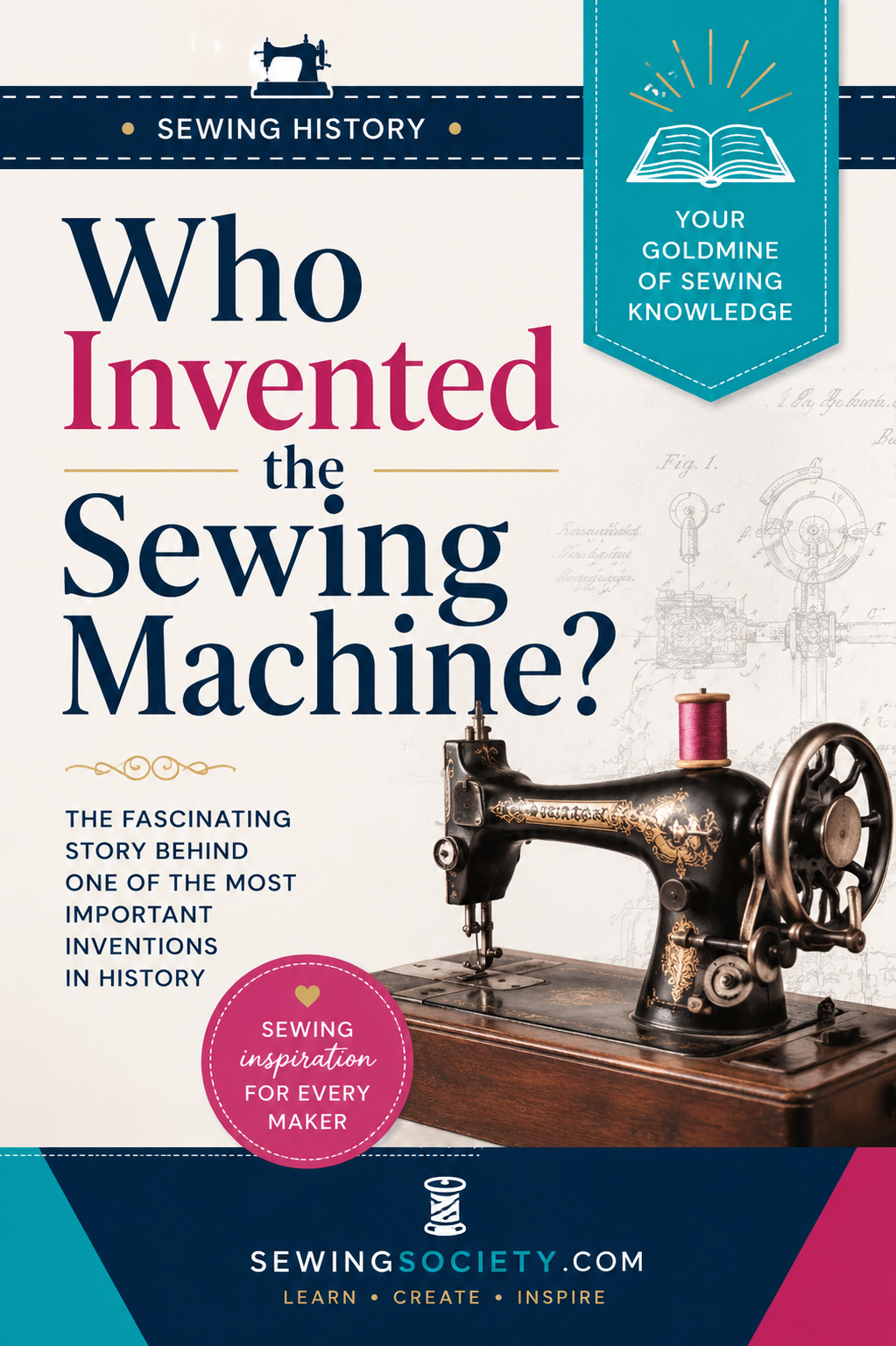
Who Invented the Sewing Machine? A Brief History
The history of the sewing machine is more complicated than most people realize. Over 300 patents cover the mechanisms that make up a single machine, and the invention evolved across multiple countries simultaneously in the mid-1800s. Here's a brief history of who actually deserves credit, from the first recorded design in 1755 to Isaac Singer's foot pedal and beyond.

The sewing machine is one of the greatest inventions of all time. It revolutionized the fashion industry, transformed manufacturing, and became a fixture in millions of households throughout the 20th century. But ask who actually invented it and you'll step into one of the most contested stories in technological history.
Sewing Before Machines
Sewing dates back roughly 20,000 years. It is one of the oldest trades in human history. The earliest needles were made from animal bones, and fabric was handwoven from natural materials like cotton, flax, and silk. The iron needle appeared in the 14th century, and the needle with an eye — the kind we still use today — came along in the 15th century (Smithsonian Institution, 2004).
The craft evolved slowly for hundreds of years, with a major leap forward following the Industrial Revolution in the late 18th and early 19th centuries, when inventors began experimenting with mechanizing the sewing process.
Who Really Invented the Sewing Machine?
The honest answer is that no single person invented the sewing machine. There are over 300 patents covering the various mechanisms that make up a working sewing machine — the feeding system, the shuttle, the lockstitch, the chain stitch, and so on (Grace's Guide to British Industrial History, 2021). The machine evolved rapidly in the 1840s and 1850s as inventors in different countries worked simultaneously, often in competition with one another. The result was decades of fierce patent disputes.
What we can say with certainty is that Isaac Singer did NOT invent the sewing machine — but he did create the most practical version and was responsible for making it affordable for home use. Singer sewing machines are still one of the most widely sold brands today.
Key Figures in Sewing Machine History
Charles Weisenthal (1755) The first recorded idea for a mechanized sewing needle came from Weisenthal, a German engineer who described a double-pointed needle with an eye in the middle in 1755. He did not patent the concept (Lewton, 1930).
Thomas Saint (1791) British cabinet maker Thomas Saint patented a sewing machine design in 1791, intended for stitching leather and canvas. No working model was ever constructed from his plans, though a model built from his patent drawings in the 1870s was found to require significant modifications before it could function (Brocklehurst, 2004).
Josef Madersperger (1814) The first recorded working model of a sewing machine is credited to Josef Madersperger, an Austrian tailor, who built a working prototype in 1814 and was granted a patent in Vienna in 1815 (Austrian Patent Office records).
Barthélemy Thimonnier (1830) French tailor Barthélemy Thimonnier was granted a patent in 1830 and may have been the first person to put sewing machines to commercial use. He opened a factory in Paris equipped with 80 of his chain-stitch machines to produce uniforms for the French Army. Local tailors, fearing the machines would put them out of work, broke into the factory and destroyed the equipment in what is considered one of the earliest examples of industrial sabotage (Cooper, 1976).
Walter Hunt (1833) American inventor Walter Hunt developed the first sewing machine to use a lockstitch design around 1833. He never applied for a patent, a decision that would come back to haunt others who later tried to claim the invention (Stein, 1999).
John Greenough (1842) The first sewing machine patent issued in the United States was granted to John Greenough in 1842 (U.S. Patent No. 2,466).
Elias Howe (1845) Elias Howe patented an eye-pointed needle and lockstitch mechanism in 1846 (U.S. Patent No. 4,750). He traveled to England to find investors, and when he returned to the United States, he discovered that multiple manufacturers — including Isaac Singer — had been using his patented design without permission. Howe spent years in court defending his patent rights and ultimately won significant royalties from those infringements (Brandon, 1977).
Isaac Merritt Singer (1850s) Singer entered the picture in 1851, when he patented improvements to an existing sewing machine design. His contributions included a straight needle (rather than curved), a presser foot, and perhaps most significantly, the foot pedal, which freed both hands to guide the fabric (U.S. Patent No. 8,294). Singer lost a patent infringement lawsuit brought by Howe but continued manufacturing. He focused heavily on making the machine accessible to ordinary households through installment payment plans, a revolutionary business model at the time. Both Singer and Howe became extraordinarily wealthy as a result of their work on the sewing machine (Brandon, 1977).
The Sewing Machine Today
The sewing machine has continued to evolve ever since. Today's machines are computerized, with touchscreen displays, hundreds of built-in stitches, automatic needle threaders, and embroidery capabilities. My own machine, the Bernette b79, has a built-in walking foot and a 6"x10" embroidery area — features that would have seemed like science fiction to those early inventors. And yet the fundamental mechanism — two threads interlocking between layers of fabric — hasn't changed much at all.
Popular sewing machine brands today include Singer, Brother, Bernina, Janome, and Husqvarna Viking, each with their own innovations built on that same centuries-old foundation.
References
Brandon, R. (1977). Singer and the Sewing Machine: A Capitalist Romance. Barrie & Jenkins.
Brocklehurst, S. (2004). "Thomas Saint and the first sewing machine patent." The Newcomen Society Transactions, 74(1).
Cooper, G. R. (1976). The Sewing Machine: Its Invention and Development. Smithsonian Institution Press.
Grace's Guide to British Industrial History. (2021). "Sewing Machine History." graces.guide.
Lewton, F. L. (1930). The Servant in the House: A Brief History of the Sewing Machine. Smithsonian Institution.
Smithsonian Institution. (2004). "Sewing Through the Ages." National Museum of American History.
Stein, L. (1999). The Triangle Fire. Cornell University Press.
U.S. Patent No. 2,466. Greenough, J. (1842). Sewing Machine.
U.S. Patent No. 4,750. Howe, E. (1846). Improvement in Sewing Machines.
 Pin It
U.S. Patent No. 8,294. Singer, I. M. (1851). Improvement in Sewing Machines.
Related reading: What's the Difference Between a Sewing Machine and a Serger?
AI Sewing Coach
Create a free account to chat with our AI Sewing Coach — trained to help with sewing techniques, troubleshooting, projects, fabric questions, and more!
Comments
Comments are screened by an AI moderator for spam and inappropriate content.
Sign in to join the conversation.
Loading comments…