December 4, 2025 · Sewing Society · 3 min read · Sewing Tools & Reviews, Sewing Room & Organization, Sewing Machines
Disclosure: As an Amazon Associate, we earn from qualifying purchases. Some links in this post may be affiliate links.
3 Machines You Need in Your Sewing Room (Beyond a Basic Sewing Machine)
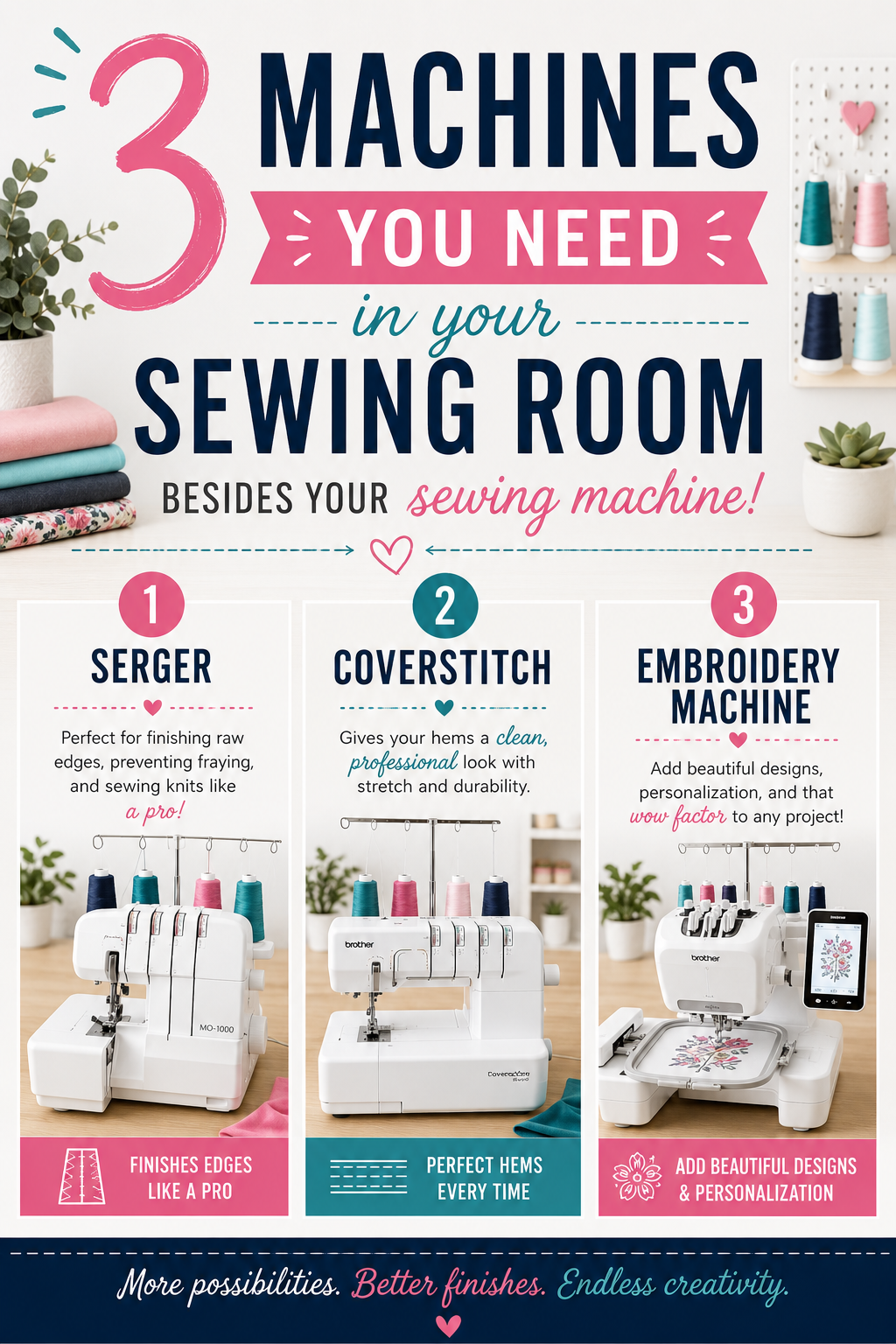
Once you outgrow your basic sewing machine, there are three machines that can genuinely transform your sewing room: a serger, a coverstitch machine, and an embroidery machine. Here's what each one does, why you might want one, and which specific models I personally recommend.

When you're first learning to sew, a basic sewing machine is all you need. But as your skills grow, you'll start to notice there are a few other machines that can make your sewing life so much easier and more fun.
The three I'm talking about are a serger, a coverstitch machine, and an embroidery machine. They each do something your standard sewing machine either can't do or doesn't do as well. Here's what you need to know about each one!
Sergers (Overlockers)
A serger is a fantastic investment if you plan to sew a lot of garments. It sews and finishes a seam at the same time, which saves a ton of time compared to doing both steps separately on your regular machine. It also creates a stretchy overlock stitch that is perfect for knits.
Some projects can actually be sewn almost entirely on a serger. Cardigans and yoga pants are great examples!
Sergers use three or four cones of thread to create the overlock stitch, and they have a built-in knife that trims your seam allowance as you sew. The finished seams look really professional.
I know a lot of people avoid sergers because threading them looks scary. There is a learning curve, I won't lie. But it's absolutely something you can master, and many modern sergers now have an air threading feature that practically does it for you.
One thing to keep in mind: a serger cannot replace your sewing machine. It can't sew buttonholes, do topstitching, attach patch pockets, or get into tight corners. But as a companion machine? It is a total game changer.
If you're shopping for a serger, I recommend the Brother 1034D. It's easy to thread and one of the more affordable quality options on the market.
Also read: What's the Difference Between a Sewing Machine and a Serger?
Coverstitch Machines
A lot of people confuse sergers and coverstitch machines, and I get it. They look similar because both use multiple thread cones. But they do completely different things.
A coverstitch machine is designed specifically for hemming stretch fabrics. It creates two parallel rows of stitching on the front of your fabric and secures the edges on the back with loops. It's what gives store-bought t-shirts and athletic wear that clean, professional hem finish. It can also create a chain stitch with a single needle.
I have the Bernette b42 Coverstitch Machine and I absolutely love it. It's one of my most-used machines.
You can buy a combination serger and coverstitch machine, but the downside is that switching between the two modes requires swapping out parts, which gets a little annoying. If you sew a lot, having two separate machines is worth it.
Also read: What Does a Coverstitch Machine Do?
Embroidery Machines
If you want to add appliques, monograms, or decorative embellishments to your projects, an embroidery machine is the way to do it with speed and precision. You upload a design, hoop your fabric, and the machine does all the work. It is so satisfying to watch!
Machine embroidery does require some supplies. Every project needs stabilizer and special embroidery thread, and there's a learning curve to uploading and positioning designs. But once you get the hang of it, the possibilities are truly endless.
Embroidery machines do come with a higher price tag. A machine with a larger hoop size can run upwards of $7,000. If you want to get started without breaking the bank, I highly recommend the Bernette b79, which is a combination sewing and embroidery machine. It has a 6"x10" embroidery area and comes with the excellent Bernina software. It gives you the most bang for your buck if you want to explore machine embroidery without a massive investment.
 Pin It
This isn't an exhaustive list of every machine you could own, but these three are the most useful additions beyond a standard sewing machine. If you do a lot of quilting, a long-arm quilting machine is also worth dreaming about, though they sit on a huge frame that takes up an enormous amount of space. One of those would fill an entire room in my house!
If you don't already have a serger, coverstitch machine, or embroidery machine, add one to your wish list. Holiday sales are a great time to watch for deals!
Related reading: What Does a Coverstitch Machine Do? (And Do You Need One?)
AI Sewing Coach
Create a free account to chat with our AI Sewing Coach — trained to help with sewing techniques, troubleshooting, projects, fabric questions, and more!
Comments
Comments are screened by an AI moderator for spam and inappropriate content.
Sign in to join the conversation.
Loading comments…