July 18, 2026 · Sewing Society · 5 min read · Fabric Guides
Disclosure: As an Amazon Associate, we earn from qualifying purchases. Some links in this post may be affiliate links.
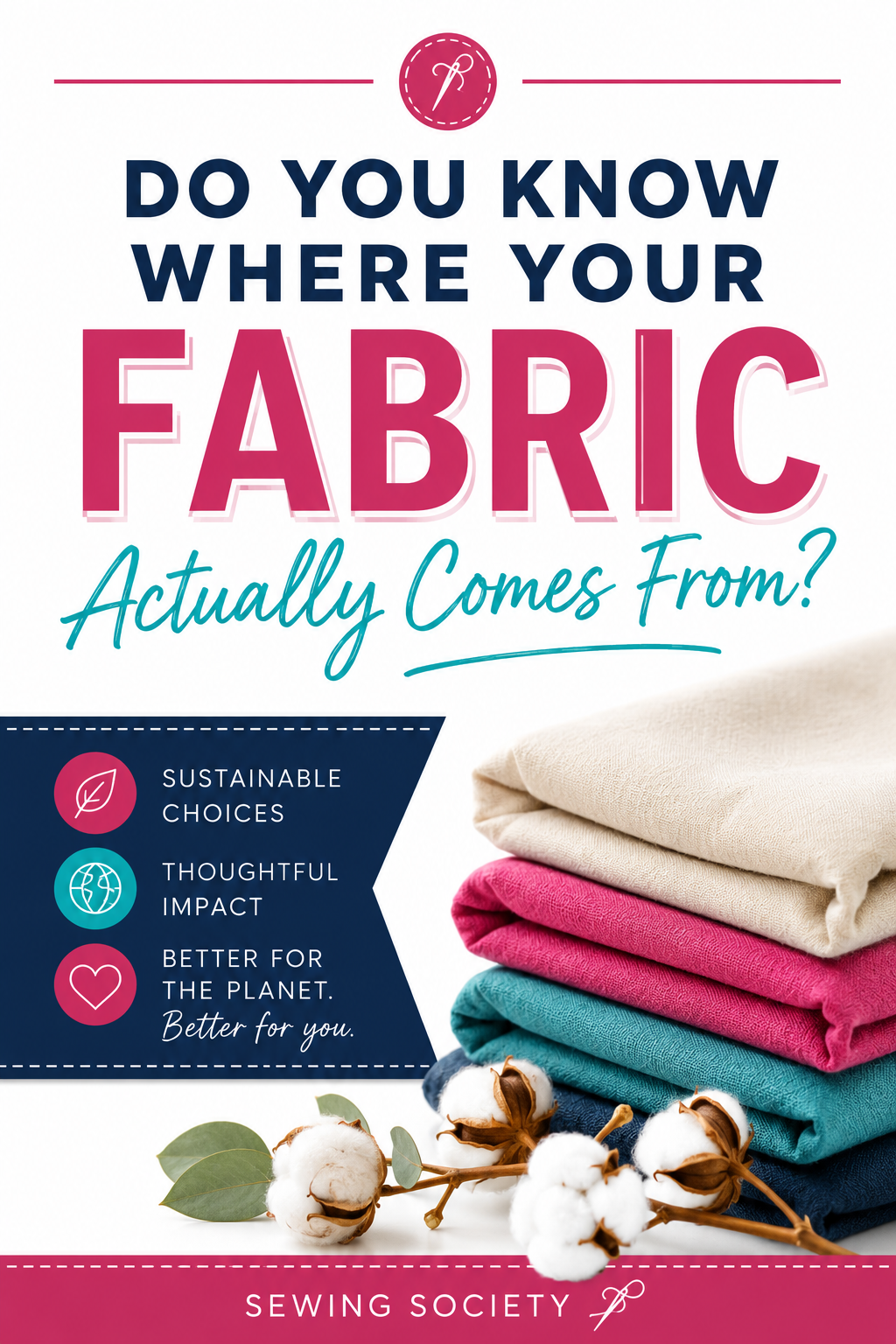
Do You Know Where Your Fabric Actually Comes From?
Ever wonder what happened to your fabric before it hit the shelf? Here's the real story, fact-checked, plus what you can actually do about it.

You pet the bolts. You check the fiber content. You maybe even squint at the price per yard and do some mental math about how many quilt blocks that's going to cost you. But when's the last time you asked where that fabric actually came from before it hit the shelf?
Not the shop it came from. The whole story before that: the farm, the mill, the dye house, all the hands and chemicals and shipping containers involved in turning a cotton boll or a barrel of petroleum into something you can cut into a nine-patch. Most of us never ask, because the industry doesn't exactly make it easy to find out. But if sustainability is part of why you sew (using up scraps, buying secondhand, avoiding fast fashion), it's worth understanding what you're actually up against, and what you can do about it that isn't just vague guilt.
Why Nobody Can Tell You Where Their Fabric Came From
Here's the annoying truth: most fabric brands can't fully answer this question either. Cotton might get grown in one country, ginned in another, spun and woven somewhere else, then dyed and finished in a fourth. Each step usually only knows about the step right before it, not the whole chain. So even a well-meaning shop selling you "sustainable" quilting cotton may genuinely not know everything that happened three steps upstream.
That opacity is the whole problem. When nobody can see the full chain, there's nowhere for accountability to live.
The Human Side: Better Than It Was, Still Not Good
Child labor in textile production is real, and it's concentrated in cotton farming in places like India, Uzbekistan, and Egypt, where kids work long hours for little or no pay, often to chip away at family debt. Here's the number worth knowing: the most recent global estimate (ILO and UNICEF, 2025) puts child labor worldwide at 138 million children as of 2024. That's down significantly from prior counts, which is genuinely good news. It's also still 138 million kids who should be in school instead of a field.
Adult workers face real risk too. The 2013 Rana Plaza factory collapse in Bangladesh killed 1,134 garment workers and became the moment the industry couldn't ignore anymore. It led to some real safety reforms. But dangerous conditions, especially exposure to the chemicals used in dyeing and finishing fabric, are still common in factories across Bangladesh, India, and Cambodia.
The Environmental Cost You Don't See on the Bolt
Two numbers actually matter here.
Cotton and pesticides. Conventional cotton farming uses a lot of pesticides for the amount of land it takes up. One widely cited figure, from the Environmental Justice Foundation, puts cotton at around 16% of global insecticide use on just 2.4% of farmland. Cotton industry groups push back hard on that number and put their actual pesticide use much lower, so treat it as contested rather than settled fact. What's not contested: cotton is not a low-input crop, which is exactly why organic cotton exists.
Dyeing and water pollution. This one's on firmer ground. The World Bank estimates textile dyeing and finishing account for roughly 20% of global industrial water pollution, mostly from untreated wastewater dumped in places with weak environmental enforcement. That's specifically industrial pollution, not "20% of all water pollution on earth," but it's still a massive share for one industry, and it's a real argument for caring about how (and where) your fabric is dyed.
Synthetics have their own problem: polyester and nylon are made from petroleum, don't break down, and shed microplastics into waterways every time they go through the wash, including in your sewing room.
Skip the Blockchain Hype
You may have seen "blockchain" pitched as the fix for all of this. Quick honest version: it's a shared digital record that can't be quietly edited later, so in theory every farm, mill, and dye house could log what actually happened at their step, and nobody downstream could erase it.
There's a real pilot of this: BASF ran one called "Seed 2 Sew" starting in 2022, tracking sustainably grown cotton from five farms in Greece all the way to finished garments. It's a legitimate proof of concept. It's also five farms in one region, not something reshaping how fabric gets made. Almost nothing you'll buy this year has a blockchain record behind it. File this under "interesting future," not "check for this at the fabric store."
What Actually Helps, Starting With Your Next Fabric Order
This is the part that matters if you're trying to sew more sustainably without turning it into a research project every time you need a fat quarter.
Learn two certifications and actually look for them. GOTS (Global Organic Textile Standard) and OEKO-TEX both mean an independent group has checked labor and chemical practices, not just taken the brand's word for it. They're not perfect, but they're a real filter.
Ask your fabric shop directly. Independent shops, especially ones carrying organic or Japanese-milled cottons, often genuinely know their suppliers and are happy to talk about sourcing. If a shop can't answer at all, that tells you something too.
Reach for natural fibers when it's an option. Cotton, linen, and wool biodegrade and don't shed microplastics the way polyester and nylon blends do. Cotton still has the pesticide issue, so organic cotton or linen are your best bets when you want both.
 Pin It
Let your stash and scrap bin do some of the work. Buying secondhand fabric, shopping deadstock, and actually using up what you already own all reduce demand on the murkiest parts of the supply chain, no investigation required.
Don't let perfect be the enemy of better. You're not going to fully audit every yard of fabric you buy, and you don't need to. Choosing GOTS-certified cotton for one project, asking your favorite shop one good question, or finally using up that fabric you've been hoarding all count.
Fabric transparency is improving, just slowly, through certifications, small pilot programs, and sewists asking better questions. You don't need to understand blockchain to sew more ethically. You need to know two labels and be willing to ask where things came from.
AI Sewing Coach
Create a free account to chat with our AI Sewing Coach — trained to help with sewing techniques, troubleshooting, projects, fabric questions, and more!
Comments
Comments are screened by an AI moderator for spam and inappropriate content.
Sign in to join the conversation.
Loading comments…