March 24, 2026 · Sewing Society · 4 min read · Sewing Machine Help & Troubleshooting
Disclosure: As an Amazon Associate, we earn from qualifying purchases. Some links in this post may be affiliate links.
Why Does My Sewing Machine Keep Skipping Stitches?
Skipped stitches happen when the hook fails to catch the upper thread loop at the right moment. The cause is almost always one of eight things: incorrect threading, the wrong or dull needle, tension imbalance, bobbin issues, lint buildup, poor thread quality, fabric too thick, or hook timing off. This guide covers each cause and exactly what to do.

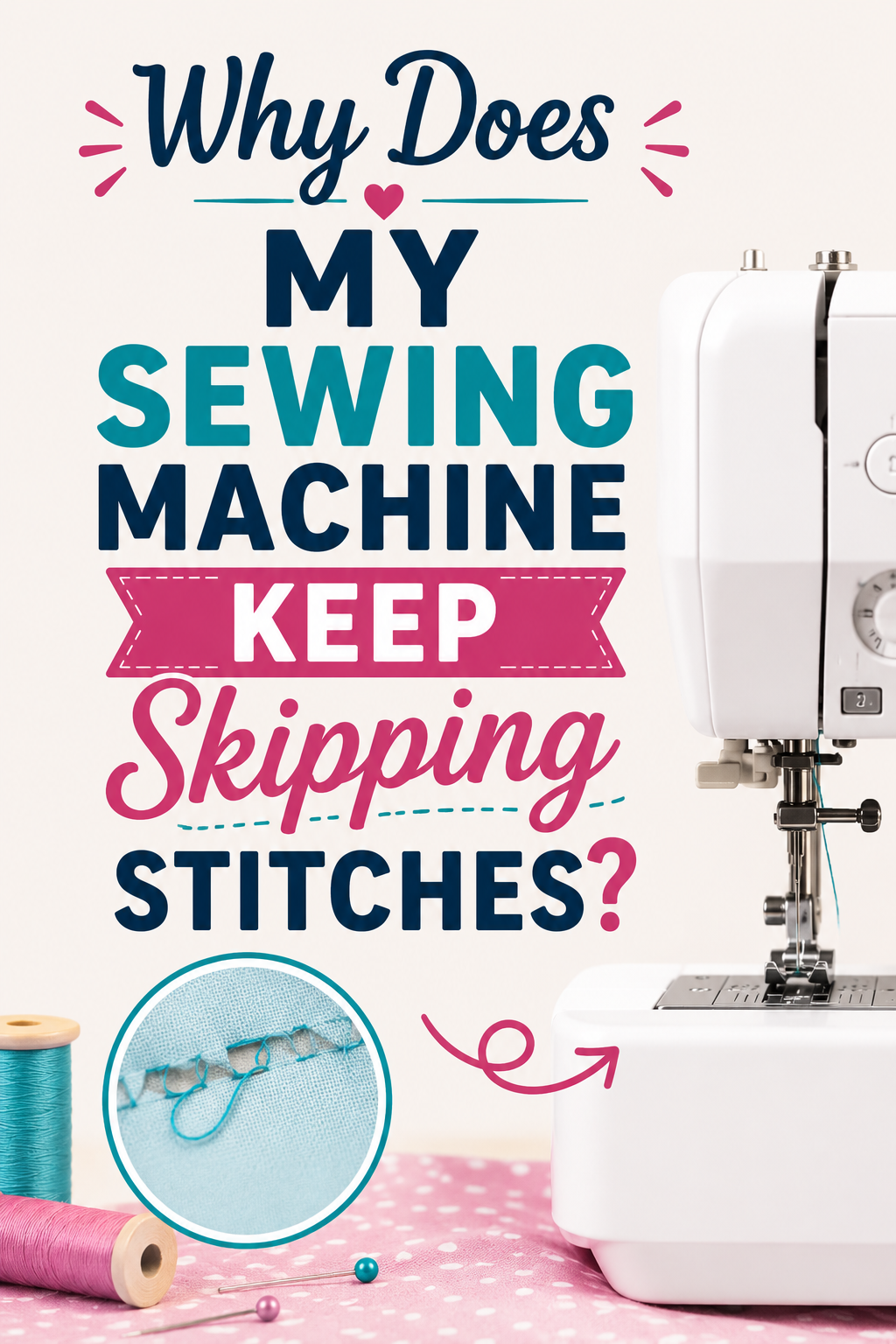
A skipped stitch happens when the hook fails to catch the upper thread loop at the right moment. The two threads do not interlock, and that stitch is simply missing from the seam. Depending on the cause, this can happen occasionally or on nearly every stitch.
Here are the most common reasons and how to fix each one.
1. The Machine Is Not Threaded Correctly
Incorrect threading is the first thing to check. When the upper thread does not pass through the tension discs and guides in the correct order, it does not have the right amount of resistance and the hook cannot form a reliable loop.
Unthread completely and start over. Make sure the take-up lever is at its highest position before threading. Follow your user manual exactly, passing through every guide in sequence, and leave a four-inch thread tail under the presser foot when finished.
2. The Needle Is Wrong, Dull, or Bent
A dull or bent needle is one of the most common causes of skipped stitches. A dull needle deflects as it enters the fabric rather than piercing cleanly, which shifts the needle tip away from the hook and breaks the stitch loop. A bent needle can miss the hook entirely on each pass.
Replace the needle and test immediately. Change the needle at the start of every project. Also make sure you are using the correct needle type for your fabric:
Knit and stretch fabrics: Ballpoint or stretch needle. This is the most common cause of skipped stitches on knits. A sharp needle pierces the loops rather than sliding between them, causing stitches to skip consistently.
Woven fabrics: Sharp or universal needle
Denim and canvas: Denim needle
Lightweight fabrics: Smaller needle size (60/8 to 75/11)
3. The Thread Tension Is Off
Tension that is too tight prevents the upper thread from looping correctly around the hook, causing missed loops and skipped stitches. Using different weight threads in the upper spool and the bobbin creates the same imbalance.
Use the same thread weight in both positions. If the tension is the issue, loosen the upper tension by turning the dial counterclockwise one step at a time and test on a scrap after each adjustment. Avoid adjusting bobbin tension unless a technician has directed you to.
4. The Bobbin Is Not Inserted Correctly
A bobbin in the wrong orientation feeds thread with incorrect resistance, which disrupts the stitch-forming timing and can produce intermittent skipped stitches, often after a few normal stitches.
Check your user manual for the correct bobbin orientation and the thread path through the tension slot. Re-insert carefully and make sure the thread clicks into the tension slot in the bobbin case.
5. The Bobbin Case Is Full of Lint
Lint buildup in the hook race restricts hook movement. When the hook cannot rotate freely, it misses the upper thread loop and the stitch is skipped.
Remove the bobbin and clean the bobbin case, hook race, and feed dog area thoroughly. Clean after every few projects, more often if you use high-linting fabrics.
6. The Thread Is Poor Quality
Inconsistent thread diameter caused by poor manufacturing creates uneven tension throughout a seam. The hook catches correctly on some stitches and misses on others.
Switch to a quality thread brand for machine sewing. You can check thread quality by letting a length hang freely — quality thread hangs smoothly, while poor thread looks fuzzy or curls. Avoid bulk thread packs, which tend to be inconsistent.
7. The Fabric Is Too Thick
When the needle cannot pierce cleanly through all layers, it deflects slightly on entry and may not be in the correct position for the hook to catch the loop. Skipped stitches at thick seam intersections or through many layers is a sign of this.
Use a needle size appropriate for the fabric weight. Slow down when approaching thick sections and let the machine work through at its own pace. Increasing the stitch length reduces the number of needle penetrations per inch, which can help. A walking foot also helps feed thick layers more evenly under the needle.
8. The Hook Timing Is Off
Hook timing is the synchronization between the needle's downstroke and the hook's rotation. The hook tip must pass behind the needle at the precise moment the needle begins to rise from its lowest point. If timing is off, the hook consistently misses the upper thread loop.
 Pin It
You can check timing by slowly turning the handwheel toward you and watching through the needle plate opening. As the needle rises slightly from its lowest point, the hook tip should be passing directly behind the needle at the level of the needle's eye. If the hook appears early, late, or is not close to the needle at all, the timing is off.
Hook timing adjustment is best done by a sewing machine technician. It is checked during every professional service appointment. Always turn the handwheel toward you — turning it the wrong direction can worsen the timing misalignment.
Related reading: Why Don't My Decorative Stitches Look Right?
AI Sewing Coach
Create a free account to chat with our AI Sewing Coach — trained to help with sewing techniques, troubleshooting, projects, fabric questions, and more!
Comments
Comments are screened by an AI moderator for spam and inappropriate content.
Sign in to join the conversation.
Loading comments…