November 8, 2025 · Sewing Society · 4 min read · Sewing Machine Help & Troubleshooting
Disclosure: As an Amazon Associate, we earn from qualifying purchases. Some links in this post may be affiliate links.
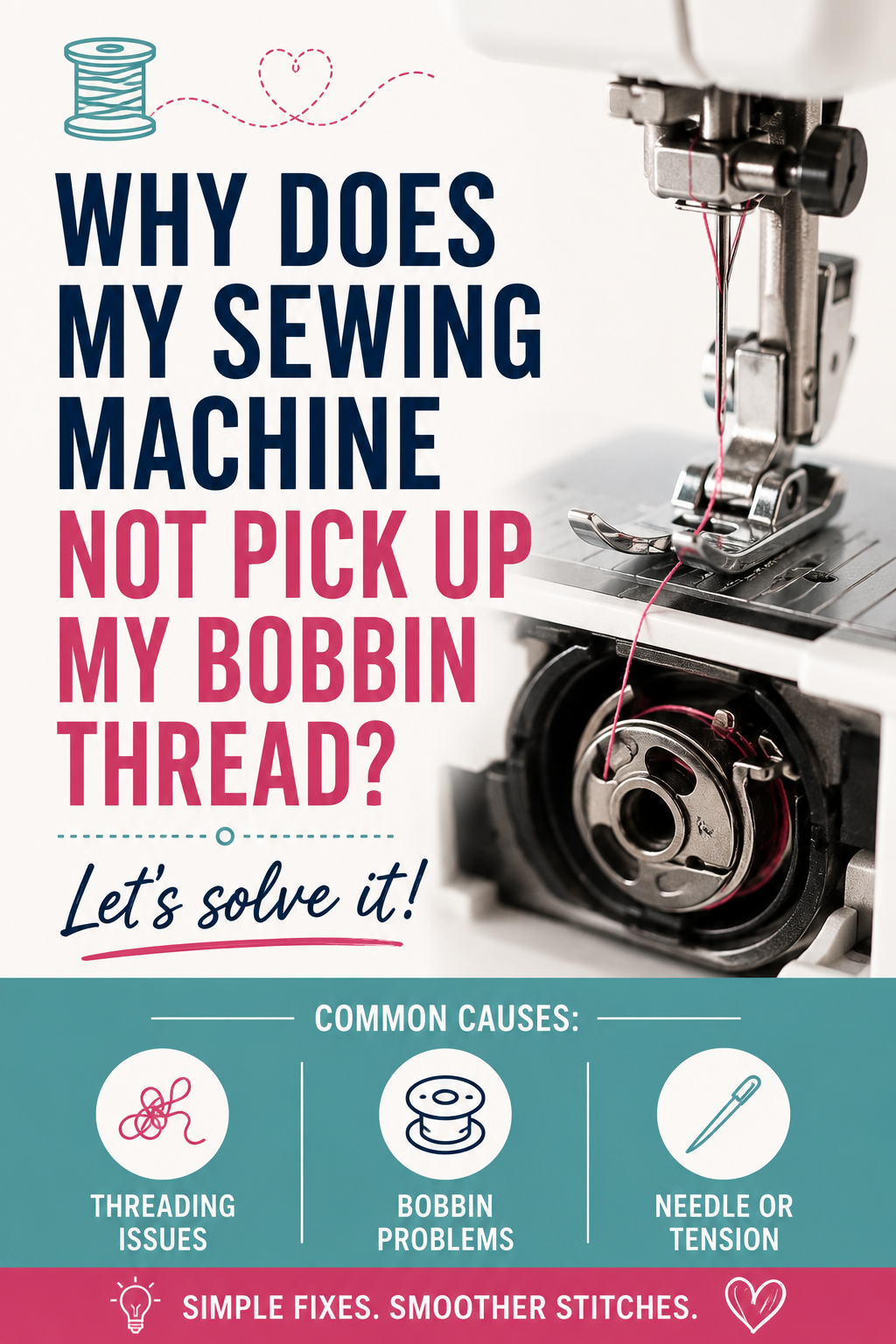
Why Is My Sewing Machine Not Picking Up the Bobbin Thread? 9 Fixes
When your sewing machine fails to pick up the bobbin thread, the cause is usually one of nine things: threading errors, short thread tails, a loose or backward needle, lint buildup, bobbin winding or insertion problems, the wrong bobbin, a warped bobbin, or hook timing that is off. This guide walks through each cause and exactly what to check.

A sewing machine needs both upper thread and bobbin thread to form a stitch. When the needle fails to catch the bobbin thread, you get tangled thread underneath the fabric, skipped stitches, or nothing at all.
On most mechanical machines, you need to manually pull the bobbin thread up through the needle plate before you start sewing. Turn the handwheel toward you one full rotation, hold the upper thread tail, and pull gently — the bobbin thread will loop up through the opening. Newer machines handle this automatically.
If pulling up the bobbin thread is not working, here are the most common reasons why and how to fix each one.
1. The Machine Is Not Threaded Correctly
Incorrect upper threading is the most common cause of bobbin thread pickup failure. If the upper thread is not passing through every guide and tension disc in the correct order, it cannot form the loop the hook needs to catch the bobbin thread.
Unthread completely and start over. Make sure the take-up lever is at its highest position before threading. Follow your user manual exactly, passing through every guide in sequence, and leave a four-inch thread tail under the presser foot when finished.
2. The Thread Tails Are Too Short
If the bobbin thread tail is shorter than two to three inches, it can get pulled back down into the machine the moment the needle descends. The upper thread needs enough bobbin thread to catch and form the first stitch.
Leave at least three to four inches of thread tail from both the needle and the bobbin when you start sewing. Hold both tails gently behind the presser foot for the first few stitches if they keep getting sucked in.
3. The Needle Is Not Inserted Correctly
A needle that is not fully seated will sit too low and miss the bobbin thread entirely on its downstroke. A needle inserted backward creates the same problem and risks breaking on contact with the bobbin case.
Push the needle shank all the way up into the clamp before tightening the screw. The flat side of the shank faces the back of the machine. Tighten the clamp screw firmly. Check periodically that the screw has not worked itself loose during sewing.
4. The Bobbin Case Is Full of Lint
Lint buildup around the hook race restricts the hook's movement and prevents it from catching the bobbin thread at the right moment. This is one of the most overlooked causes of stitch formation problems.
Remove the bobbin and clean the bobbin case, hook race, and feed dog area thoroughly with the brush that came with your machine. Clean after every few projects, or more often if you use high-linting fabrics like fleece or flannel.
5. The Bobbin Is Not Wound Correctly
An unevenly wound bobbin causes the thread to feed inconsistently, which can prevent the upper thread from catching it. A knot in the bobbin thread or a bobbin wound too full will also cause pickup failures.
After winding, check that the thread is layered evenly across the bobbin. Never fill the bobbin past the edge — leave a small margin. If your machine's built-in bobbin winder is producing uneven bobbins, the winder tension disc or rubber ring may need replacing. A standalone bobbin winder is a good workaround if the built-in winder is worn out.
6. The Bobbin Is Not Inserted Correctly
Bobbins must be inserted in a specific orientation. Some machines require the thread to unwind clockwise in the bobbin case, others counterclockwise. Inserting it the wrong way means the thread feeds in the wrong direction and the hook cannot catch it.
Check your user manual for the correct bobbin orientation and the proper thread path through the bobbin case tension slot. Most machines have a diagram printed on the bobbin case door or inside the compartment.
7. You Are Using the Wrong Bobbin
Bobbins look nearly identical across brands, but size variations exist. A bobbin that is even slightly too thick or too large will not seat correctly in the bobbin case and the hook will miss the thread.
Always use bobbins designed specifically for your machine model. Check your user manual for the correct bobbin class. If you are not sure, bring your machine to a sewing machine dealer to get the right bobbins.
8. The Bobbin Is Warped or Damaged
Plastic bobbins can warp from heat, which causes them to sit unevenly in the bobbin case and spin erratically. A warped bobbin will not feed thread consistently.
If you suspect a warped bobbin, wind a fresh one and discard the old one. Store bobbins away from heat sources, direct sunlight, and car interiors where temperatures can spike. Metal bobbins are less susceptible to warping if this is a recurring issue.
9. The Hook Timing Is Off
Hook timing is the synchronization between the needle's downstroke and the hook's rotation. The hook must catch the upper thread loop at a precise moment to pull the bobbin thread through. If the timing is off even slightly, the hook misses the loop entirely.
You can check timing by slowly turning the handwheel toward you and watching through the needle plate opening. As the needle rises slightly from its lowest point, the hook tip should pass directly behind the needle at the level of the needle's eye. If the hook is early, late, or missing the needle entirely, the timing is off.
 Pin It
Hook timing adjustment is a mechanical repair. It is checked during every professional service appointment. If you are comfortable with the mechanics, some timing adjustments can be done at home, but this is best left to a technician unless you have experience with it.
Always turn the handwheel toward you. Turning it away from you can knock the timing out of alignment.
Related reading: Are Sewing Machine Bobbins Universal? (Spoiler: They're Not)
AI Sewing Coach
Create a free account to chat with our AI Sewing Coach — trained to help with sewing techniques, troubleshooting, projects, fabric questions, and more!
Comments
Comments are screened by an AI moderator for spam and inappropriate content.
Sign in to join the conversation.
Loading comments…